

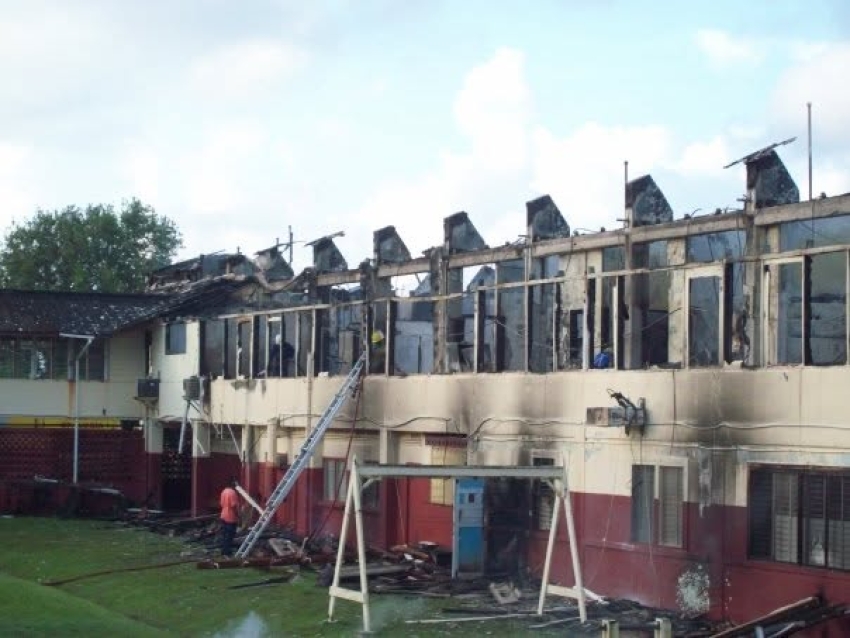
What followed became a prolonged national ordeal: patients treated in a converted stadium, successive governments changing the course of reconstruction, and public money committed across years of unfinished work.
Today, there is firmer reason for hope. The rebuilt hospital at Augier has been handed over, and services have begun moving into it. Yet this anniversary still calls for both remembrance and accountability. Progress towards commissioning is tangible; confirmation that the entire hospital is fully operational remains outstanding in the public sources reviewed for this article.
St. Jude’s story began long before the disaster. Its buildings originated in the wartime Beanefield Military Hospital, later abandoned and eventually restored for civilian healthcare. Mother Irma and the Sisters of the Sorrowful Mother helped transform the neglected facility into a charity hospital, formally opened on September 5, 1966. Government assumed responsibility in 1992, continuing an institution already deeply rooted in the life of southern Saint Lucia. Just four days before this year’s fire anniversary, St. Jude marked 60 years since its opening.
That history makes the events of September 9, 2009 especially painful. According to the National Emergency Management Organisation’s annual report, the fire broke out at approximately 1 a.m., destroying the surgical wing and two operating theatres. Forty-seven patients were in the hospital. Forty-four were safely evacuated; two died in the blaze, and another succumbed to burn injuries while being transported to Victoria Hospital.
Behind those figures were three people whose families never received the homecoming they expected. Their loss must remain at the centre of this anniversary, even as the national conversation turns to buildings, contracts and commissioning.
The emergency also revealed extraordinary public courage. Staff, emergency responders and community members helped rescue patients and restore services. George Odlum Stadium became the hospital’s temporary home an emergency solution that stretched across much of a generation.
Throughout those years, healthcare workers continued delivering care in difficult surroundings. In 2016 alone, St. Jude reported treating 47,355 patients, performing 1,053 surgeries and delivering 643 babies. Those numbers record the work of an institution that continued serving its community while waiting for adequate accommodation.
Reconstruction passed through the administrations of Stephenson King, Kenny Anthony, Allen Chastanet and Philip J. Pierre. The project became entangled in disputes about design, standards, cost and which buildings should be completed. After reconstruction was halted in 2016, the Chastanet administration pursued a new facility, with work beginning in 2019. Its stated justification was that the earlier buildings did not meet hospital standards.
The Pierre administration subsequently returned to completing the original buildings, restarting site work in November 2022. Each change of direction brought fresh expectations for a population still waiting to leave the stadium.
In his 2022 budget address, Pierre reported that EC$98 million had been spent between 2010 and August 2016. He also stated that EC$118 million had been spent on the later facility by July 2021. Together, those reported expenditures amounted to EC$216 million before the subsequent completion programme.
The competing assessments were substantial. Chastanet argued that preliminary estimates in 2017 indicated another EC$100 million would have been required to complete the earlier facility, citing concerns about planning and standards. That position helps explain the political dispute; it does not, by itself, settle which approach represented better value.
A major new financing commitment came in August 2023, when the Saudi Fund for Development signed a US$75 million loan agreement for reconstruction and rehabilitation. Contracts followed in September 2024. The loan provided a route towards completion.
The clearest turning point came on November 16, 2025, when the completed facility was formally handed over. The government explicitly distinguished that milestone from commissioning the preparation needed before the hospital can safely deliver its full range of services.
By April 2026, physiotherapy, administration and finance had moved to Augier, and laundry operations had begun. Officials described testing electrical, plumbing, ventilation and information systems while preparing further departments for occupation. A reported three-to-four-month target for full opening raised expectations again.
Then came a significant clinical advance: the hospital reported that its dialysis unit began operating at the new facility on July 28, with patient care maintained throughout the transition. For patients dependent on regular dialysis, that move gives practical meaning to the promise of returning home.
An end is therefore in sight, supported by completed construction and services already operating at Augier. This anniversary belongs first to the people who died, their families, and those who carried St. Jude through the years that followed. Completing the hospital will honour that endurance. Sustaining it with reliable services, proper maintenance and transparent management will determine whether the country has learned from the long journey back.