

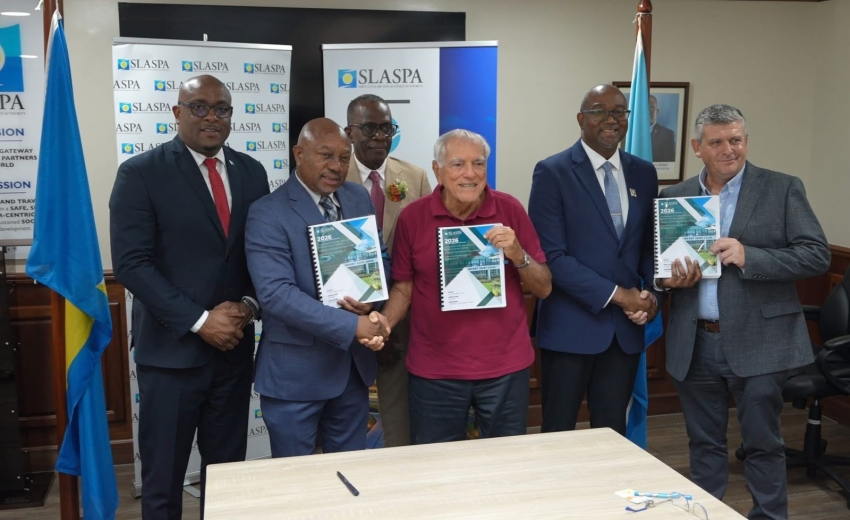
The warning accompanied the signing of the contract for Packages Two and Three of the redevelopment, covering the new terminal building and airside facilities. The ceremony took place at the Saint Lucia Air and Sea Ports Authority’s (SLASPA) headquarters on October 20.
Pierre explained that the project had been delayed because his administration insisted on international competitive tendering, rather than proceeding with the direct award granted under the previous administration. He stressed that the scale of the undertaking required accountability from the agencies entrusted with its delivery.
NH International (Caribbean) Limited secured the contract following an open international bidding process.
In his address, the Chairman of the Ports Council said the procurement opportunity was advertised locally, regionally and internationally between June and November 2025. Twenty-seven firms obtained tender documents, and seven ultimately submitted proposals.
Bidders submitted separate, sealed technical and financial proposals. Technical submissions were assessed first, with only three firms meeting the threshold for their financial proposals to be opened. NH International emerged as the best-evaluated bidder.
The Chairman said independent engineering, quantity surveying and legal professionals guided the process, with evaluations documented and reported to SLASPA’s Procurement Committee.
“The Council’s responsibility does not end with today’s signature,” he stated, pledging continued oversight throughout construction.
SLASPA General Manager and Chief Executive Officer Daren Cenac outlined plans for a three-storey terminal spanning approximately 274,000 square feet, featuring expanded passenger facilities, modern baggage handling, new immigration and customs facilities, restaurants and retail spaces.
For the first time at Hewanorra, passenger boarding bridges will allow travellers to move directly between the terminal and aircraft, sheltered from the weather.
The apron will expand by more than 500,000 square feet, increasing aircraft parking positions from six to eleven and accommodating aircraft as large as the Boeing 777.
Energy and water efficiency also form part of the plans. A groundwater-based cooling system is expected to reduce cooling energy requirements by approximately 20 to 25 per cent while avoiding reliance on WASCO’s domestic water supply. A solar carport is planned within the wider airport development.
Construction is scheduled to run through the end of 2029, followed by a full year of operational readiness and airport transfer before the terminal opens. The existing airport must remain operational throughout the works.
The terminal’s piled foundation has already been completed, while the new control tower is being built under a separate contract. A further package covering roads, parking and access will follow.
Cenac said an independent professional team would oversee standards, scheduling and costs, while keeping SLASPA informed throughout implementation.
“Signing this contract is the beginning, not the end,” he said. “The real work starts now.”